Directorate for Transport and Communications (T&C) is the leading section within the ECO Secretariat for initiating, coordinating and monitoring ECO projects and programmes in transport and communications.
Connectivity has always been a major priority area for the ECO and its Member States. This is important for at least two reasons. First, the ECO Region is composed of land-locked and transit countries. Three ECO transit countries have significant potential and capacities to unlock the potential of the 7 land-locked Member States through connecting them to the global markets. Second, the ECO Region matters for neighbouring countries and regions. It has significant and unparalleled capacity to facilitate international trade through connecting China to Europe, and Russia and North Europe to Persian Gulf, Oman Gulf and Indian Ocean.
The ECO Ministers of Transport, in their first meeting in Almaty in October 1993, adopted the “Almaty Outline Plan for the Development of the Transport Sector in the ECO Region”. The Extraordinary ECO Summit in Ashgabat in March 1997 endorsed the “Programme of Action for the ECO Decade of Transport and Communications”. These two important documents were followed by conclusion of the “ECO Transit Transport Framework Agreement” (TTFA) in 1998, which established the “Transit Transport Coordination Council” (TTCC) as intergovernmental mechanism responsible for achieving the TTFA’s goals and objectives through monitoring, implementing and coordinating matters related to transit transport within the ECO Region.
Over the years, all ECO Summits and Council of Minsters meetings have underscored in their policy guidance the continued and increasing significance of transport and transit for the ECO Region. Ministers of Transport of the Member States, in their regular meetings, have translated this high-level political will into frameworks for regional cooperation and coordination in transport and transit and its related areas. The last ECO Ministerial Meeting on Transport was held in June 2025 in Tehran and focused, inter alia, on digitalization and sustainability. As per the mandate given by the Meeting, which is also reflected in its “Tehran Declaration”, the Directorate is preparing the “ECO Sustainable and Resilient Transport Strategy for 2026–2035”. The next ECO Ministerial Meeting on Transport will be held in 2026 in Kazakhstan.
The Directorate is also engaged in ECO ICT-related activities. The new and emerging technologies, including AI, have gained increasing attention in the ECO Region. Huge benefits and considerable risks and threats attributed to these technologies have generated momentum in the ECO to collectively address them.
In May 2016, the “Joint ECO-ITU Study on ICT Needs of ECO Member States” was released. On the basis of the Study, the “2025 ECO Regional Strategy on ICT” was drafted and finalized. In the light of drastic ICT developments, a new five-year ICT strategy for the ECO Region is under consideration.
The ECO Ministerial Meeting on ICT is the highest decision-making body for regional cooperation on ICT. The last ICT Ministerial Meeting was held in Tehran in 2023. The next Ministerial Meeting on ICT is expected to take place in the first quarter of 2026 in Pakistan.
****
In advancing its various mandates in transport and communications, the Directorate is engaged in, and promoting, various partnerships with relevant technical, development and financing partners from within and outside the ECO Region.
Director and Staff
Dr. Seyed Jalaledin Alavi Sabzevari (Iranian national)
Director for Transport & Communications
Tel: (+9821)22831733-34
Email: alavi@eco.int
Mr. Zeinolla Kalymbetov (Kazakh national)
Programme Officer
Tel: (+9821)22831733-34
Email: zeinolla@eco.int
Mr. Bayram Aganyyazov (Turkmenistan national)
Programme Officer
Tel: (+9821)22831733-34
Email: aganyyazov@eco.int
Mr. Ikramboy Khayitbaev (Uzbek national)
Programme Officer
Tel: (+9821)22831733-34
Email: khayitbaev@eco.int
Mr. Javed Ali (Pakistani national)
Desk Officer
Tel: (+9821)22831733-34
Email: javed@eco.int
Publication
 FINAL REPORT PROJECT FOR DEVELOPMENT...
  FINAL REPORT PROJECT FOR DEVELOPMENT...
  ИТОГОВЫЙ ОТЧЕТ ПРОЕКТ РАЗВИТИЯ АВТОМОБИЛЬНОГО...
 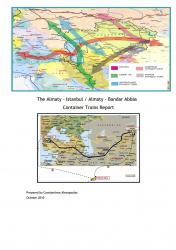 The Almaty – Istanbul /...
  FEASIBILITY STUDY ON IMPLEMENTATION OF...
  ECO Regular Monitoring of Trucks...
  ECO Railway Network Development Plan-Corridor...
  Joint ECO-ITU Study on ICT...
 ECO/UNECE/lsDB GIS Project
A geographic information system (GIS) is a type of database containing geographic data (that is, descriptions of phenomena for which location is relevant), combined with software tools for
managing, analyzing, and visualizing those data. In a broader sense, one may consider such a system to also include human users and support staff, procedures and workflows, body of knowledge of relevant concepts and methods, and institutional organizations.